Brand and Campaign Registration
- Privacy Policy
- TCR Brand Registration Requirements Guide
- 10DLC Key Attributes to get your Campaign Approved
Privacy Policy
The privacy policy is a non-negotiable requirement for all brands to ensure compliance with 10DLC regulations. Businesses are required to clearly state how consumer data is collected, used, and protected. The privacy policy must explicitly state that the brand does not share information with third parties for marketing purposes, even if they don’t engage in such practices.
Requirements:
- The Privacy Policy must be publicly accessible on the website, ideally located in the footer section to ensure visibility and easy access for users.
- If the brand already has a privacy policy in PDF format but does not have it published on the website, embedding that document on the website is a valid option.
- For brands that do not have a website, this is still required and may be submitted as a PDF attachment. However, it must ultimately be made easily accessible to consumers through appropriate channels.
- Clear Description of Data Use:
- Privacy Policy must clearly state what Personally Identifiable Information (PII) are collected (e.g. phone numbers, names, location, etc.)
- State how information is used.
- Must state that consumer PII will not be sold, rented, or shared with third parties for marketing purposes.
- To ensure compliance, this language must be added:
- No phone/mobile number information will be shared with third parties/affiliates for marketing/promotional purposes. All the above categories exclude text messaging originator opt-in data and consent; this information will not be shared with any third parties.
What to do if a brand does not have a Privacy Policy?
- Create a Privacy Policy: draft a privacy policy by outlining how the brand collects, use, store, and protect user data. Be sure to include information like:
- The types of data collected (e.g., phone numbers, names, etc.)
- How data is used (e.g., for sending messages)
- Whether they share data with third parties (e.g. service providers)
- How users can opt-out or request their data be deleted
- Add this language:
- No phone/mobile number information will be shared with third parties/affiliates for marketing/promotional purposes. All the above categories exclude text messaging originator opt-in data and consent; this information will not be shared with any third parties.
- The statement above indicates that data categories such as names and addresses will be shared with third parties, excluding text messaging opt-in data and consent, which are handled separately and not shared.
- Use a Privacy Policy Generator: If the brand doesn’t have the resources to write a policy from scratch, they can explore online tools that can help generate a privacy policy tailored to their needs. These tools can give them a basic template to work with.
- Consult with a Legal Professional: have a lawyer review their privacy policy, especially if the brand operates in a regulated industry or if unsure about specific legal requirements.
TCR Brand Registration Requirements Guide
Due to the ever-changing nature of the 10DLC Messaging Initiative, this guide may quickly be outdated, however you will be updated on the information when trying to register your Brand.
Information Needed
Note: If a system message is sent to recipients within a Brand's Campaign, it will include the name entered within the 'DBA or Brand Name if different from legal name' field during Brand Registration.
A. WHEN REGISTERING A PRIVATE COMPANY
Legal company name, country of registration, Employer ID Number (EIN) / Tax ID, address, vertical, and contact details.
B. WHEN REGISTERING A PUBLIC COMPANY
Legal company name, country of registration, Employer ID Number (EIN) / Tax ID, address, website address, vertical, stock symbol, stock exchange, and contact details.
C. WHEN REGISTERING A CHARITY / NON-PROFIT ORGANIZATION
Legal company name, country of registration, Employer ID Number (EIN) / Tax ID, address, vertical, and contact details.
Note: If registering as a Non-Profit with a 'Charity' Special Campaign Use Case, you must also use the EIN and Legal Company name that matches your Federal Government Registration as a Non-Profit, and you must have a 501(c)(3) tax-exempt status to qualify as a Non-Profit Organization.
D. WHEN REGISTERING A GOVERNMENT ENTITY
Legal company name, country of registration, Employer ID Number (EIN) / Tax ID, address, vertical, website, and contact details.
Entering the correct Tax ID
The Tax ID number is used in conjunction with the company’s name, address, and other information to ensure we perform a background investigation on the correct company. The following guidelines provide the best verification opportunity for your company.
United States
If you are a US company or a foreign company with a US IRS Employer Identification Number (EIN), please enter the nine-digit number found in the EIN field and ensure that your legal company name is consistent with your IRS registration, including proper spelling. The address you enter should also be the same as that used in registering with the IRS.
Canada
On July 27th, TCR will switch to only accepting the Business Number (BN) rather than the Corporation/Incorporation/Registry ID numbers for Canadian Brand Registration. Until that time we will accept either the BN or the Corporation/Incorporation/Registry ID numbers. We will only accept the first 9 numeric digits of the BN (BN-9).
Here is an example of the format of a BN where the bolded part is the part we will collect in the Canadian Brand:
Tax/Corporation ID field: 123456789RT0001
Brand Identity Verification
Each Brand will automatically go through an Identity Verification process. TCR validates the EIN, Legal Company Name, and Legal Company Address with third-party independent sources and confirms the existence of the Brand with a verification “Status” (Verified/Unverified).
Being a ‘Verified’ Brand is a requirement to message on 10DLC, and Identity Verification is a crucial step for each registered Brand. We suggest paying attention to entering correct and up-to-date information to allow the Brand to be swiftly verified.
The outcome of Identify Verification shall be communicated to the Reseller upon submission of the form within one business day via email.
‘Unverified’ Brands
Unverified Brands cannot register 10DLC campaigns, they must obtain the ‘Verified’ status if they wish to do so. These are the options available:
- Any ‘Unverified’ Brand can be resubmitted for verification for a fee of $4.
- Any ‘Unverified’ Brand can request or import external Vetting through a third-party vetting process for an additional fee of $40.00 (Aegis Mobile). We will provide instructions on how to do this if your brand is reported back to you as “Unverified”.
In both cases, it is crucial that details about the Brand are corrected and updated before any submission.
Class/Tier assignment flow for Brands
For companies (Brands) who are a member of the Russell 3000, TCR will automatically assign available Classes (AT&T) or Tiers (T-Mobile) to their Brand. Verified Brands that are not part of the Russell 3000 list can improve their Class/Tier assignment through vetting.
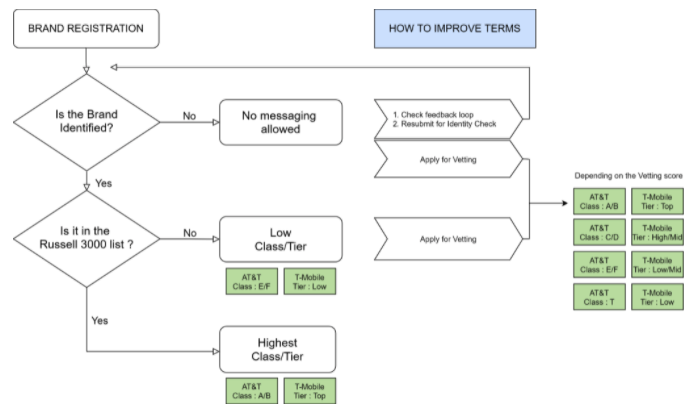
Vetting
CSPs can apply for vetting on behalf of the Brand through one of TCR's external vetting partners to gain access to special use cases or improve the quality of service (where applicable). The current Vetting partner used today is Aegis, there is an additional one-time fee of $40.00.
Brand Details Update
In case of errors during Brand registration or change in Brand information over time, TCR allows updating your Brand information and resubmission of your Identity Verification for a fee of $4.00.
Website/Online Presence
Please make sure to include any website or online presence the customer has. This can include a social media page, as long as our aggregator can access it and verify the business is who they say they are. Even if the customer avoids putting their website, our aggregator will search for the business to see if there’s any associated website. If there is prohibited content on their website, the campaign will be rejected.
| Acceptable | Rejected | |
|---|---|---|
| Website |
|
|
| Facebook, Instagram, Twitter, and other social media page |
|
|
|
|
|
| Yelp |
|
|
| Profile Sites |
|
IMPORTANT: sample Opt In language that can be added to webforms if used to collect phone numbers:
By clicking " Submit " I agree to receive emails, text messages, and phone calls, which may be recorded and/or sent using automated dialing or emailing equipment or software unless I opt-out from such communications. I also agree to the Terms of Use and Privacy Policy linked below. I understand that my consent to be contacted is not a requirement to purchase any product or service and that I can opt-out at any time. I agree to pay my mobile service provider's text messaging rates, if applicable."
10DLC Key Attributes to get your Campaign Approved
Pre-Registration Guidelines
These factors are critical for a successful registration process, so addressing them thoroughly can help avoid rejections:
- Prohibited Content: Including content that falls under ineligible use cases will result in denial.
- Lead Generation/Affiliate Marketing: Collecting or selling consumer information for leads. This practice is strictly prohibited for 10DLC.
- Website Compliance: Missing or non-compliant opt in language, privacy policies, or terms of service can negatively impact your registration.
- Inadequate Opt-In Process: Not having a clear and compliant opt-in process for consumers can result in rejection
- Insufficient Use Case Description: Not clearly defining how the messages will be used may lead to rejection.
- High-Risk Industry: Industries like financial services, real estate and insurance may undergo additional scrutiny and face higher rejection rates
Phone Number and Email
- Phone Number: The contact number of the person managing the messaging for the brand being registered.
- Email Address: The company email address associated with the brand, preferably a company email domain (e.g., contact@yourcompany.com) that matches the brand being registered.
Website/Online Presence
Brands must have a legitimate, well-established website that meets all necessary criteria. A website is essential for 10DLC campaign approval, as it serves as a key verification tool for the Direct Connect Aggregator (DCA), or “aggregator” to confirm the business’s legitimacy and compliance. The aggregator will review the website to ensure it aligns with the brand and campaign content. Without a website, the campaign will be rejected.
Each website must contain a Privacy Policy page to be accepted.
Note: Any other online presence (such as Facebook, Instagram, etc.) will ONLY be acceptable if the brand does not have an official website. However, they also must have a Privacy Policy.
Use Case
As mandated by MNOs, TCR requires the CSP to declare a Use Case at the beginning of the Campaign Registration process. Select the appropriate use case that would best align with the type of content you intend to send.
- Standard Use Cases are immediately available for all qualified registered Brands and do not require Vetting or pre/post approval by MNOs.
- Special Use Cases are sensitive or critical in nature and may require Vetting or pre/post-registration approval by MNOs. Requirements may vary according to each MNO.
IMPORTANT: Do not select the 'Low Volume Mixed' use case if the brand sends high volume traffic. Applying for external vetting to improve throughput will have no effect on campaigns with this use case. A new campaign would need to be registered using appropriate use cases, such as Mixed, Customer Care, Account Notifications, etc. as only these are eligible for throughput enhancement through external vetting.
Campaign Description
A Campaign Description includes the intended purpose of the overall messages. A few examples of this are sending appointment reminders, sending 2FA codes, responding to inquiries, sending transaction notifications, or providing customer support updates.
Your campaign description should answer the questions:
- Who are you?
- Who do you want to reach?
- What type of messages do you intend to send?
For Example:
- Messages aimed at customers of a car dealership service center. Appointment reminders, repair updates, satisfaction follow-up, online bill payment, and 2-way conversations.
- We will be sending out 2FA codes for login and password reset. Additionally, users will also receive codes after they have signed up with their phone number to validate the phone and activate their account.
Sample Messages
The sample messages should show the kind of messages that would be sent by the campaign. A sample message is required for each use case selected. The message should be relevant to the specific use case and the purpose of messaging described in the campaign description.
Requirements:
- These messages should be specific to the campaign’s intended use and not a generic set of messages that have nothing to do with the use case.
- You must provide samples that are different from each other and give examples of what you might send so that the DCA can see how the exchange might look.
- Ensure each message is relevant to your chosen use case and reflects typical communication scenarios for your campaign.
- Maintain consistency in message content with what was registered to prevent campaign drift and avoid your campaign from being blocked or suspended.
IMPORTANT: If the Campaign & Content Attributes for embedded links and phone numbers are checked as "Yes," please provide a sample message that shows this.
Call-to-Action / Message Flow
An explanation on how the brand obtains the numbers and consent from the consumers they text. If there are multiple methods involved, it must be disclosed in the CTA (Call-to-Action).
Consent Prompt (double opt in)
- Consent Prompt is a method designed to confirm a consumer’s consent twice. This process is used to ensure that the recipient has explicitly opted in to receive text from the Brand.
- Enabling this feature improves the likelihood of campaign approval. It assures the DCA and carriers that consent is explicitly obtained.
- Once the campaign is approved with this setting on, you will no longer be able to turn it off. Disabling this setting will require you to register a new campaign, adhering to 10DLC guidelines.
IMPORTANT: Carriers have the authority to reject campaigns and require double opt-in. When this happens, we cannot override their decision. Carriers may require this if they determine that the consent process is insufficient or if they identify any potential risks related to the brand based on their own internal vetting process.
Website
Brand collects consent when consumers fill out a webform on the website, providing their explicit consent to receive SMS from the brand.
Requirements:
- Provide the exact URL(s) where the webform is located.
- The form must contain SMS disclaimer:
- Brand Name
- Program Description (messages consumers expect to receive from the brand)
- “Message & data rates may apply.”
- “Message frequency may vary.”
- “You can text HELP for support or STOP at any time to unsubscribe.”
- Link to Privacy Policy and Terms - must direct to the brand's own Privacy Policy, not to a third-party
- The SMS disclaimer must contain a checkbox alongside it:
- The checkbox must not be pre-checked.
- Checking the box must be optional for users to submit the form.
- For campaigns that intends to send marketing messages, the phone/mobile number field must be optional.
- However, if the form is exclusively intended for SMS use, the phone number field may be required.

- However, if the form is exclusively intended for SMS use, the phone number field may be required.
- If the brand sends marketing and non-marketing SMS options, the SMS disclaimer must be broken out. Marketing SMS Disclaimer can't be merged with other programs and checkbox for other programs.
- If the website is not disclosed as part of the opt-in process, but the webform clearly indicates phone numbers will be used for SMS communication (as implied in the existing SMS Disclaimer), this should be included in the CTA. However, if the existing SMS disclaimer is not in compliance, the brand needs to either:
- Revise the webform to meet requirements.
- If the webform is not intended for SMS communication, completely remove any SMS related disclaimer to prevent rejection.
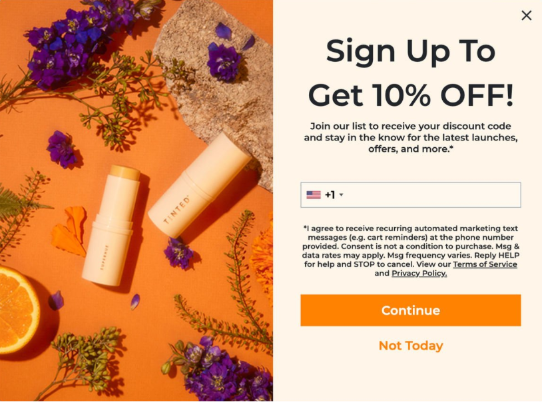
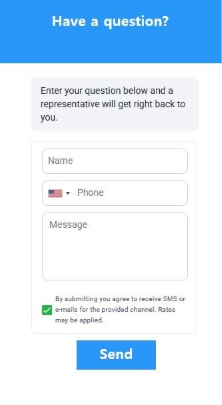
The above SMS disclaimer does not meet compliance requirements and needs to be either updated or removed.
Suggested SMS Disclaimer Table
|
Non-Marketing SMS Disclaimer
|
Marketing SMS Disclaimer
|
| I consent to receive text messages about [NON-MARKETING PROGRAM DESCRIPTION] from [Brand Name] at the phone number I provided. I acknowledge that my consent is not a condition of purchase. Msg & data rates may apply. Msg frequency varies. Reply HELP for assistance or STOP to opt out of receiving messages. Privacy Policy [link] & Terms [link] (where applicable). | I consent to receive marketing text messages, such as [MARKETING PROGRAM DESCRIPTION], from [Brand Name] at the phone number I provided, including messages sent via auto dialer. I understand that my consent is not a condition of purchase. Msg & data rates may apply. Msg frequency varies. Reply HELP for assistance or STOP to opt out of receiving messages. Privacy Policy [link] & Terms [link] (where applicable). |
|
Sample non-marketing program description:
|
Sample marketing program description:
|
Example non-marketing SMS Form:
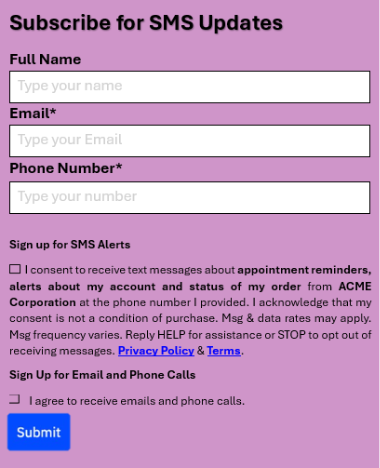
Example Mixed Form (Marketing and Non-Marketing):
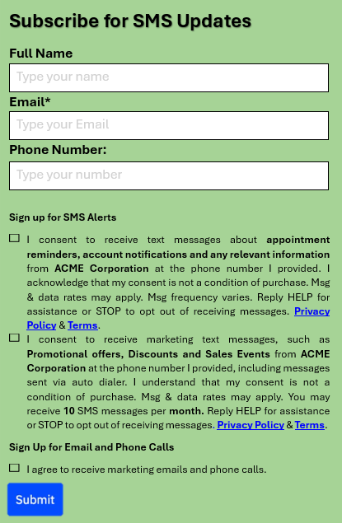
IMPORTANT: Do not use language in the SMS Disclaimer that could be seen as a forced opt-in, such as "By submitting," "By completing this form," or similar phrases.
Form
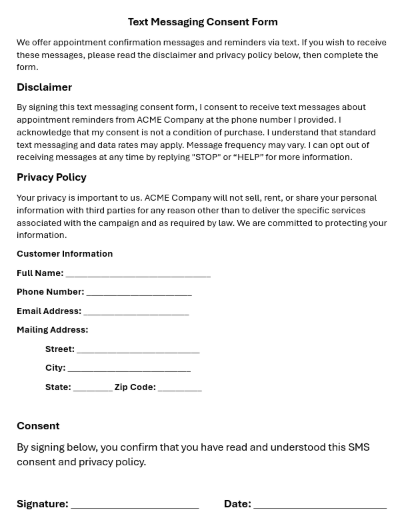
Consumers opt in by completing/signing a form to give written consent.
Requirements:
- Attach a copy of the physical form. Add an explanation of how consumers can access this form. This must be uploaded to the CTA Multimedia section when submitting the campaign.
- The form must contain the necessary SMS Disclaimer:
- Brand Name
- Program Description (messages consumers expect to receive from the brand)
- “Message & data rates may apply.”
- “Message frequency may vary.”
- “You can text HELP for support or STOP at any time to unsubscribe.”
- Information how the brand handles SMS data or a direct link to the privacy policy
Sample Form:
Verbal
Consumers opt in to the brand by providing verbal consent.
Requirements:
- Provide the scenario in which the verbal exchange took place: For example, a phone call or face-to-face conversation.
- Provide the script used when obtaining verbal consent. Script must include the following SMS disclaimers:
- Brand Name
- Program Description (messages consumers expect to receive from the brand)
- “Message & data rates may apply.”
- “Message frequency may vary.”
- “You can text HELP for support or STOP at any time to unsubscribe.”
- “Visit our website to view our privacy policy at www.abc.com/privacy-policy”
- For marketing messages, double opt-in is highly recommended to ensure approval.
- Verbal consent can be the initial step, but a follow-up SMS confirmation should be sent to the consumer to get the consumer's explicit consent for marketing messages.
- This piece is vital because verbal consent are typically not documented and can therefore be difficult to prove in the event of any dispute.
Verbal consent script sample:
Do we have your permission to send appointment reminders via text from ACME Corp to the number provided? Standard message and data rates may apply. Message frequency may vary. You can reply HELP for support or STOP to opt out of future messages. For more details, please visit our privacy policy on our website.
Keyword/Text
Consumers opt in by texting an opt-in keyword to a phone number associated with a brand, giving explicit consent.
Requirements:
- Provide proof (screenshot or link) on which the opt in instructions is displayed
- Instruction must include the Keyword customer needs to use to opt in: e.g., START, SUBSCRIBE, OPT IN, etc.
- Provide the phone number to which consumers need to text the opt in keyword
- Instruction or advertisement must contain SMS Disclaimer:
- Brand Name
- Program Description (messages consumers expect to receive from the brand)
- “Message & data rates may apply.”
- “Message frequency may vary.”
- “You can text HELP for support or STOP at any time to unsubscribe.”
- Link to Privacy Policy and Terms
QR Code
A QR code allows consumers to opt-in by scanning a code.
Requirements:
- Provide a copy of the QR code or provide a link where consumers can access this. The QR code must be uploaded in the CTA multimedia section.
- The QR code must let users know what to expect when they scan the QR code. For example, "Scan this QR code to opt in to messaging!"
- QR code instructions must contain SMS Disclaimer:
- Brand Name
- Program Description (messages consumers expect to receive from the brand)
- “Message & data rates may apply.”
- “Message frequency may vary.”
- “You can text HELP for support or STOP at any time to unsubscribe.”
- Link to Privacy Policy and Terms.
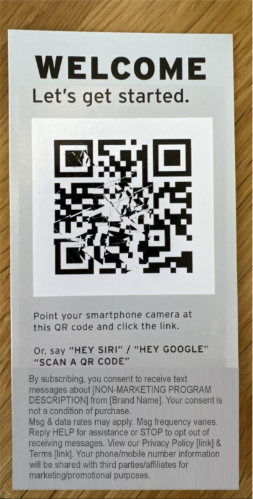
Note: The QR code should be tested prior to submitting the campaign to ensure it works as expected. Scan it to verify that it leads to the correct destination (whether it’s a sign-up page, landing page, etc.), and check for any potential issues like broken links or misdirects.
Privacy Policy
The privacy policy is a non-negotiable requirement for all brands to ensure compliance with 10DLC regulations. Businesses are required to clearly state how consumer data is collected, used, and protected. The privacy policy must explicitly state that the brand does not share information with third parties for marketing purposes, even if they don’t engage in such practices.
Requirements:
- The Privacy Policy must be publicly accessible on the website, ideally located in the footer section to ensure visibility and easy access for users.
- If the brand already has a privacy policy in PDF format but does not have it published on the website, embedding that document on the website is a valid option.
- For brands that do not have a website, this is still required and may be submitted as a PDF attachment. However, it must ultimately be made easily accessible to consumers through appropriate channels.
- Clear Description of Data Use:
- Privacy Policy must clearly state what Personally Identifiable Information (PII) are collected (e.g. phone numbers, names, location, etc.)
- State how information is used.
- Must state that consumer PII will not be sold, rented, or shared with third parties for marketing purposes.
- To ensure compliance, this language must be added:
- No phone/mobile number information will be shared with third parties/affiliates for marketing/promotional purposes. All the above categories exclude text messaging originator opt-in data and consent; this information will not be shared with any third parties.
What to do if a brand does not have a Privacy Policy?
- Create a Privacy Policy: draft a privacy policy by outlining how the brand collects, use, store, and protect user data. Be sure to include information like:
- The types of data collected (e.g., phone numbers, names, etc.)
- How data is used (e.g., for sending messages)
- Whether they share data with third parties (e.g. service providers)
- How users can opt-out or request their data be deleted
- Add this language:
- No phone/mobile number information will be shared with third parties/affiliates for marketing/promotional purposes. All the above categories exclude text messaging originator opt-in data and consent; this information will not be shared with any third parties.
- The statement above indicates that data categories such as names and addresses will be shared with third parties, excluding text messaging opt-in data and consent, which are handled separately and not shared.
- Use a Privacy Policy Generator: If the brand doesn’t have the resources to write a policy from scratch, they can explore online tools that can help generate a privacy policy tailored to their needs. These tools can give them a basic template to work with.
- Consult with a Legal Professional: have a lawyer review their privacy policy, especially if the brand operates in a regulated industry or if unsure about specific legal requirements.
Terms & Conditions
The terms and conditions can either be presented as part of the call-to-action (CTA) or via a dedicated webpage on the website. Pop-ups cannot be used to display terms and conditions.
This is required for all 10DLC messaging campaigns. This typically outlines general business practices. However, what the DCA is looking for are the terms related to messaging such as:
|
Brand Name and Program Description
|
By voluntarily providing your mobile phone number and explicitly opting in to SMS, you consent to receive SMS messages from [Your Brand Name] related to [describe the purpose, e.g., "order updates, promotional offers, or account notifications"]. |
|
Message and Data Rates
|
Standard message and data rates may apply depending on your carrier. |
|
Message Frequency |
|
|
Opting Out
|
You may opt out of receiving SMS messages at any time by replying with "STOP" to any SMS message you receive from us. After opting out, you will receive a confirmation message, and we will cease sending SMS messages to your number. |
|
Help Information |
If you need assistance or have questions about our SMS service, reply with "HELP" to any SMS message you receive, or contact our customer support team at [support contact information]. |
|
Privacy Policy
|
Your phone number will be handled in accordance with our Privacy Policy, available at [link to Privacy Policy]. We do not sell or share your phone number with third parties except as required by law. |
Campaign & Content Attributes
Campaign and Content Attributes refers to the specific characteristics of the messaging, such as the type of content, and any elements included in the message. During the Campaign registration process, you will be asked to answer ‘Yes’ or ‘No’ to indicate whether the Campaign has the following attributes. Some attributes may require you to add specific information:
- DIRECT LENDING OR LOAN ARRANGEMENT
- Indicates whether the campaign includes content related to direct lending or other loan arrangements
- Businesses such as auto sellers, vehicle dealerships, to name a few, often provide or arrange financing, even if it's not their primary business. In these cases, check this attribute as “Yes”.
- EMBEDDED LINK
- Indicates whether the campaign will send an embedded link in the messages.
- If “Yes” is checked, we need to provide a sample message that includes an embedded link.
- Note that public URL shorteners (bitly, tinyurl, etc.) are not accepted.
- EMBEDDED PHONE NUMBER
- Indicates whether the campaign will send embedded phone numbers in the messages (excluding providing a contact for HELP in the help response).
- If “Yes” is checked, we need to provide a sample message that includes an embedded phone number.
- AGE-GATED CONTENT
- Select “Yes” if the SMS content is intended for consumers of legal age. Businesses must ensure that individuals are verified and meet the age requirements before they can opt-in to receive text messages.
- The following content are age restricted and can be accepted with proper age-gating procedures:
- Alcohol
- Tobacco
- Firearms
- The age-gate mechanism must verify the consumer's date of birth both during the opt-in process for consent and upon entering the website.
- The following types of content are strictly prohibited, regardless of age-gating measures:
- CBD-based Products: This includes CBD oils, tinctures, edibles, topicals, vapes, patches, skincare products, beverages, and similar items.
- Cannabis and Other Illegal Substances: This applies to both recreational and medical cannabis, even in areas where it is legal, as well as any other illegal substances.
IMPORTANT: Non-acceptable age gating function includes but is not limited to Yes or No responses.
- SUBSCRIBER OPT-IN
- Indicates whether the campaign is collecting and processing consumer opt-ins. This is mandatory for all campaign types.
- Opt-In Keywords: If subscribers can opt-in via a keyword, enter that keyword here. Example: START, SUBSCRIBE, OPT IN
- Opt-In Message: This is the response message consumers receive upon explicitly opting in. The response message will include the following:
- Acknowledgement of opt in from the Brand
- Message Frequency disclosure
- Message and Data rates may apply disclosure
- HELP and STOP information
- SUBSCRIBER OPT-OUT
- Indicates whether the campaign is collecting and processing consumer opt-outs. This is mandatory for all campaign types.
- Opt-Out Keywords: This field is pre-filled with the universal STOP keyword. If you accept additional opt-out keywords, you can enter them here.
- Example: OPT OUT, UNSUBSCRIBE, QUIT
- Opt-Out Message: This is the response message consumers receive upon opting out. The response message will include the following:
- Confirmation that the consumer will no longer receive messages from the brand
- Instructions how to opt in again
- HELP information
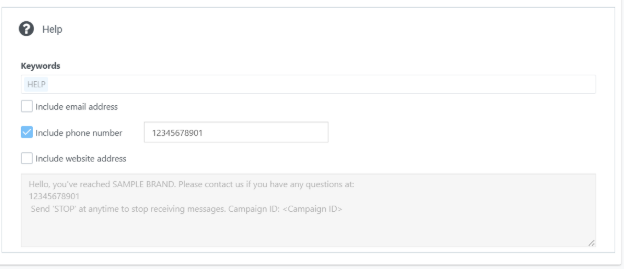
- SUBSCRIBER HELP
- Indicates whether the campaign has implemented message reply providing customers on how they can contact the message sender after they reply with the “HELP” keyword. ConnectUC assists in implementing the response to Help. The response to Help keyword is set up at the time of campaign registration.
- Help Keywords: This field is pre-filled with the universal HELP keyword. If you accept additional help keywords, you can enter them here.
- Help Message: This is the response message consumers receive upon texting HELP. The response message will include the following:
- Brand name
- Brand contact information: Email address, phone number or website link
- STOP information

- TERMS & CONDITIONS
- An attestation that Affiliate Marketing will not be a part of this campaign.
What to Avoid
- Explicit consent for marketing messages: Unlike transactional or informational messages, brands sending marketing messages face stricter compliance checks and risks campaign rejections without explicit opt in process.
- Forced language: Don’t use language that could be seen as a forced opt-in, such as "By submitting," "By completing this form," or similar phrases.
- Implied opt-ins: this is only valid for one-time communication. Explicit consent is required for ongoing or recurring messages. The first message must come from the consumer.
- Campaigns that rely solely on implied opt-in without double opt-in will not be accepted
- Don’t use vague language when obtaining consent; the message should be clear about receiving SMS communications.